
Passport
The Complete History and Guide to Singapore Passports and NRICs
Historical Evolution: From Colonial Papers to Biometric Fortresses
The Identity Card Story
Singapore’s identity documentation system has evolved dramatically from its colonial origins. The first identity cards were introduced in 1948 by the British colonial government, initially as blue paper documents for people born in Singapore. This was primarily a security measure to identify and weed out undocumented people, and “undesirable persons” during the Malayan Emergency period
Security enhancements continued: 2003 saw optical variable ink (colour-shifting text), and 2013 added negative embossing with microtext. In 2017, mandatory re-registration at age 55 was introduced (in addition to existing requirements at 15 and 30), officially to update biometric data but also enabling the state to maintain current records on all citizens
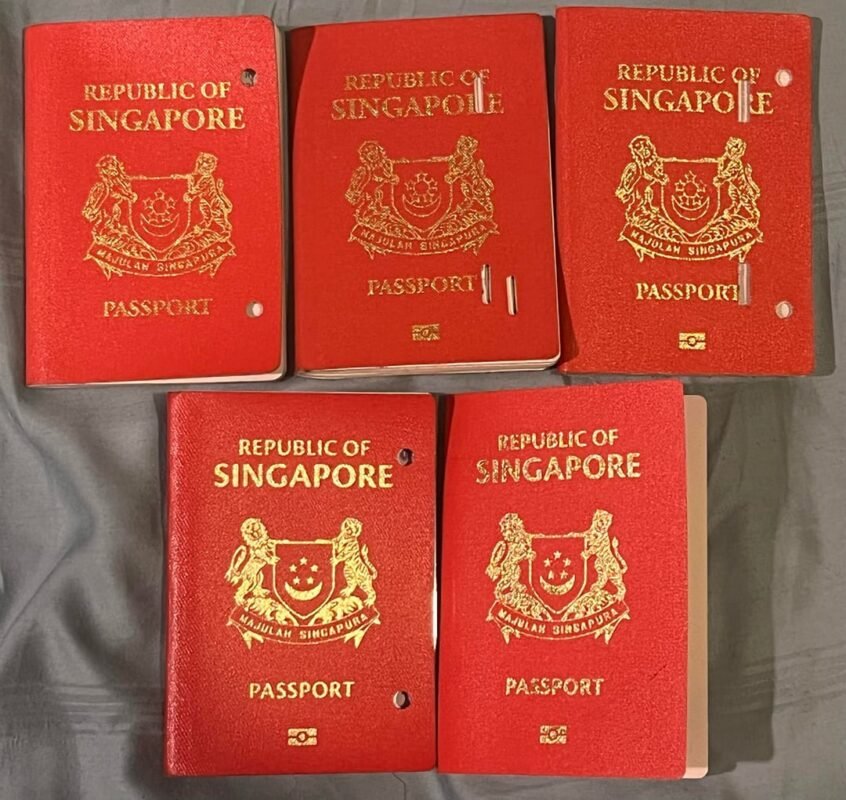
The Passport Story
Singapore’s passport history reflects its turbulent political journey. In 1959, British passports issued in Singapore were modified to reflect internal self-governance. From 1964-1965, Singapore citizens received Malaysian passports with the prefix “E” during the brief merger with Malaysia
The 2002 launch of APPLES (Application for Passport Online Electronic System) made Singapore one of the first countries to offer full online passport applications, including photo submission and payment. Biometric passports (BioPass) launched in 2006, storing fingerprints, facial images, and passport details on contactless chips Ica.
In 2021, passport validity for citizens 16 and above was extended from 5 to 10 years, reducing renewal frequency. This was framed as a convenience measure but also reduced ICA’s workload
Current Legal Framework and Requirements
Who Must Register
NRIC registration is compulsory for:
- All Singapore citizens upon reaching age 15 (must register before their 16th birthday)
- All Singapore permanent residents upon reaching age 15
- Any person who becomes a Singapore citizen or permanent resident at any age
- Re-registration is required at ages 30 and 55 for security and biometric updates
Who Can Get a Singapore Passport
Only Singapore citizens can apply for Singapore passports. The passport serves as both a travel document and proof of citizenship. Permanent residents, regardless of how long they’ve lived in Singapore, cannot obtain Singapore passports
Newborn Singapore citizens can apply for passports from birth. From January 2020, first passport application fees are waived if applied for before the child’s first birthday via MyICA
Application Process: What Most Sources Don’t Fully Explain
For NRIC (15-year-old registration)
The standard process for government school students:
Two weeks before the designated school registration date, students receive notification,
- Biometrics (fingerprints, iris scan, photo) are captured at school on the designated day
- The IC is later collected at the school
Required documents (digital images):
- Recent passport-sized colour photograph (taken within 3 months, meeting ISO/ICAO standards)
- For name changes: deed poll with consent from both parents (and legal guardians if applicable). If only one parent consents, a court order empowering unilateral action is required
Fees: S$10 for citizens; S$50 for permanent residents
Critical detail most sources omit: ICs not collected within three months are destroyed with no refund, and a new application (with new fees) is required. The state does not hold uncollected documents indefinitely
For Passports
Eligibility conditions (all must apply):
- First-time application
- Passport running out of pages
- Passport expired or expiring within 9 months
- Passport lost or damaged
Application methods:
- Online via MyICA (using Singpass): S$70 fee
- In-person at ICA Services Centre or Singapore Overseas Mission: S$80 fee
Required documents:
- Passport-sized digital colour photograph (taken within 3 months, meeting ISO/ICAO standards)
- For overseas applicants: additional documentation may be required
Processing times:
- Local applications: 1-2 weeks under normal circumstances; up to 4 weeks if photos are rejected or if there are name/surname changes
- Overseas applications: 4-6 weeks minimum
Passport validity:
- Citizens 16 and above: 10 years
- Citizens below 16: 5 years
- For 5-year passports, it will be allowed up to 9 months of remaining validity from expiry to be carried over to new passports.
What Most Sources Leave Out: The Unspoken Realities
1. The NRIC Number as Social Control Tool
The NRIC number isn’t just an identifier—it’s a population control mechanism. The format (e.g., S1234567A) encodes
This means anyone with your NRIC number can determine your exact birth date (the algorithm is publicly known), your citizenship status, and whether you’re a foreigner. This has led to widespread privacy concerns, and in 2018, the government issued advisories against organizations collecting full NRIC numbers unnecessarily.
2. The Biometric Trap
Once you enroll biometrics (fingerprints, iris scan, facial image), there is no legal mechanism to withdraw consent or have the data deleted. The National Registration Act gives the state permanent custody of this data. Even if you renounce citizenship, your biometric data remains in ICA databases.
3. The “Lost Passport” Black Mark
Multiple lost/damaged passport applications create an unofficial denylist. While not publicly acknowledged, ICA tracks replacement frequency.
The penalty fees (S$50/S$100) are framed as administrative costs, but they function as deterrents against carelessness—and the system flags repeat offenders.
4. The Name Change Maze
Changing your name on an NRIC or passport is far more difficult than most realize:
For minors: both parents must consent, or a court order is required
Permanent residents face additional hurdles: they must first update their home country passport before ICA will consider a name change
The Citizenship Renunciation Trap
Singapore does not allow dual citizenship for adults. If you renounce Singapore citizenship:
- Your NRIC must be surrendered
- Your passport is cancelled
- You lose the right to live/work in Singapore
- But your biometric data remains in ICA databases indefinitely
There is no “right to be forgotten” in Singapore law. The state retains permanent records of all former citizens.
The Philosophical Underpinning: Identity as State Property
What distinguishes Singapore’s system from most democracies is the explicit framing of identity documents as state property, not citizen rights.
This is not a bug—it’s a feature. The system was designed by a government that prioritizes security, order, and population control over individual privacy or convenience. The fact that Singapore has one of the world’s most secure identity systems is undeniable. The fact that this security comes at the cost of significant privacy trade-offs is equally undeniable.
Practical Advice for Applicants
Pertain for an NRIC at 15:
- Complete online registration immediately upon notification
Requesting for a passport:
- Apply online via MyICA (cheaper and faster)
- Ensure your photo meets exact specifications (rejections cause massive delays)
- Apply well before any planned travel (1-2 weeks minimum)
- Never report a passport as “lost” unless it truly is—penalties are severe and repeat incidents trigger investigations
If you are overseas:
- Plan for 4-6 week processing times
- Ensure you have Singpass access (may require Singapore mobile number)
- Apply well before your current passport expires
- Consider the disadvantages of living abroad when making citizenship decisions
This information is provided for educational purposes only. Immigration and citizenship laws are complex and subject to change. Always verify current requirements with ICA directly athttps://www.ica.gov.sgor through official channels.
